How We Turn ‘Okay Content’ into ‘Wow Content'
Guest posting is an integral part of most SEO strategies, and oftentimes, we do it in bulk for our clients, which requires a large number of articles to be created consistently. And, at times, the suitable way to scale is through AI.

Guest posting- the SEO activity where we write an article and publish it on another website to reach a new audience, get cited, and increase credibility. It’s an integral part of most SEO strategies, and oftentimes, we do it in bulk for our clients, which requires a large number of articles to be created consistently. And, at times, the suitable way to scale is through AI.
However, AI-generated content comes with a clear limitation. Even when the sentences are grammatically correct, the content feels repetitive, lacks a natural tone, and does not connect ideas properly.
To resolve this issue, many of our clients use humaniser tools to change sentence structures so that the content sounds more natural. But, they aren’t perfect either.
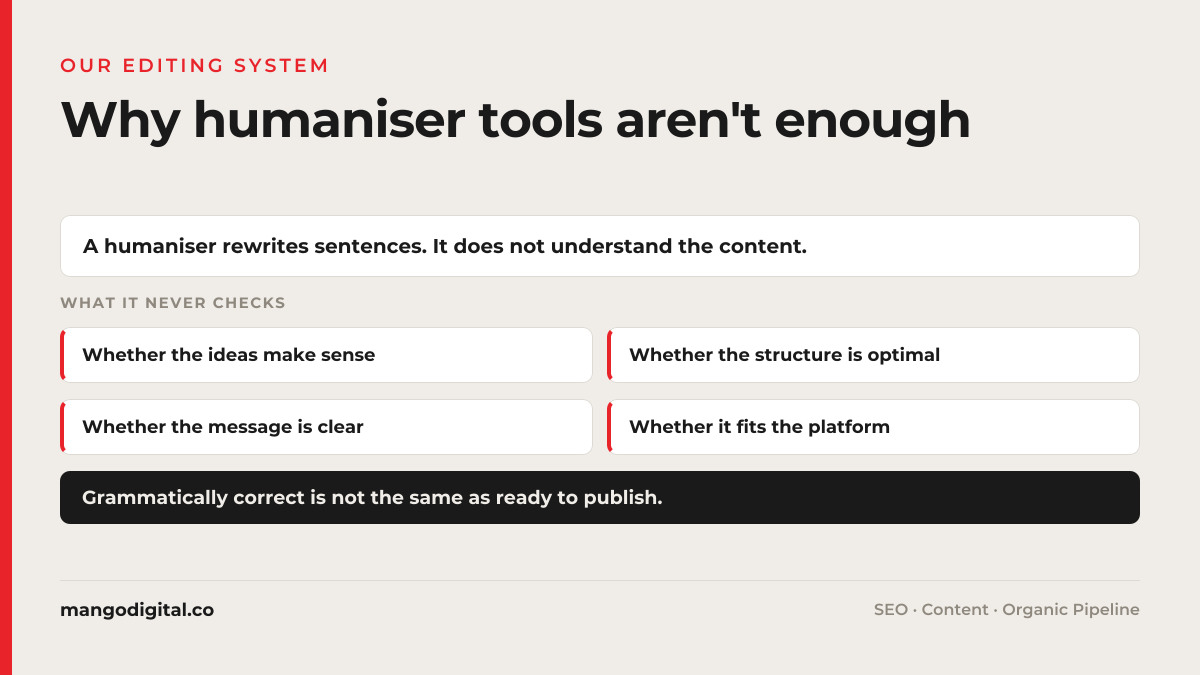
Humaniser tools do not actually understand the content. They do not check:
- whether the ideas make sense
- whether the structure is optimal
- whether the message is clear
- whether the content matches the requirements of the platform
As a result, even after humanising, the content is still not ready for publishing. This is the exact stage where our editing team comes in.
We receive content that is:
- generated using AI
- processed through a humaniser
- but still lacking clarity, structure, and alignment
We don’t rewrite from scratch. We systematically refine what already exists and make it usable, readable, and publish-ready.
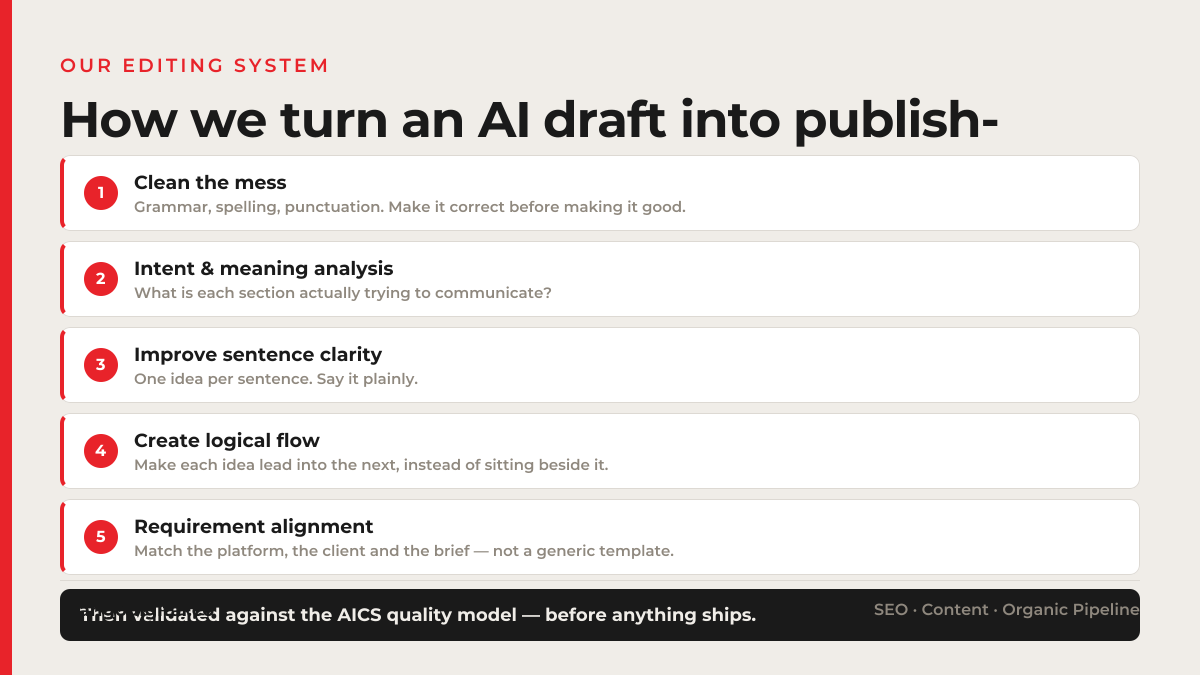
(reviewed)
Cleaning the Mess (Basic Fixing Stage)
The first layer of editing focuses on correcting the most visible issues in the content. At this stage, we define “errors” as problems related to:
- Grammatical mistakes (for example, incorrect verb forms or tenses
- Spelling mistakes (incorrect or inconsistent word usage)
- Punctuation mistakes (missing commas, run-on sentences, incorrect sentence endings)
We go through the content line by line and correct these issues without changing the meaning of the sentences.
We do not try to improve the style immediately. We first make it correct:
This step is important because if the base layer of the content is incorrect, then higher-level improvements like clarity, structure, and flow will not work properly. This step creates a stable foundation for the rest of the process.
Intent & Meaning Analysis
We identify what each section of the content is trying to communicate. It can be:
- Explaining a concept
- Providing information
- Supporting a point
- Leading towards a decision
For each paragraph, we check:
- What is the main idea?
- Is the idea clearly expressed?
- Are multiple ideas mixed together?
If a paragraph contains multiple ideas, we split it or restructure it.
This step ensures that each section has one clear purpose and the reader understands what is being communicated.
Improving Sentence Clarity
A sentence can be grammatically correct and still be difficult to understand. This usually happens when the text has:
- Long sentences
- Redundant information
- Vague phrases
We simplify this by:
- Breaking long sentences into shorter ones
- Removing filler phrases
- Replacing general words with specific ones
The meaning remains the same, but the text becomes easier to understand.
Creating Logical Flow Between Ideas
“SEO helps websites rank higher on search engines. Many businesses invest in social media marketing to grow their brand. Content quality is also important for engagement.”
All three points are valid, but they do not connect. The ideas shift without explanation, and the reader has to figure out how they relate.
After editing:
“SEO helps websites rank higher on search engines, which increases visibility. Higher visibility brings more users to the website, where content quality plays an important role in engagement. Along with this, businesses also invest in social media marketing to expand their reach and support overall growth.”
Poor flow happens when sentences do not connect, topics change abruptly, or ideas are placed without a clear relationship. We examine how each sentence leads to the next. If the connection is missing, we add it. If the order is incorrect, we rearrange it so that one idea logically leads to another.
This ensures that the reader does not have to guess the connection and can move through the content smoothly.
Requirement Alignment (Client-Specific Layer)
Every content task comes with specific requirements. When we say “requirements,” we are referring to:
Tone – the style of writing (for example: formal, conversational, neutral)
Structure – how the content is organised (headings, paragraph length, formatting)
SEO elements – keyword placement, internal or external links
Workflow rules – how the editing process itself should be executed
How do we apply this
Before starting the editing, we extract and map all requirements from the task. Then we apply them during the editing process. The process is:
- Identify all instructions given in the task
- Map each instruction to the relevant part of the content (for example, placing the anchor link in the 2nd or 3rd paragraph and adding an external link in the middle from a high-authority, non-competitor website)
- Re-check all requirements before finalising
Case Study: Workflow-Based Editing Requirement
The client required not only content editing but also a defined editing workflow.
- Edit the document in suggestion mode.
- Create a tracked copy of the document after editing.
- Resolve all suggestions and deliver a clean final document.
So, this is what we did:
Step 1: Open and Set Editing Mode
We open the given document and switch the editing mode to suggestion mode.
Step 2: Editing in Suggestion Mode Only
We complete the entire editing process in suggestion mode. This includes:
- Grammar correction
- Sentence clarity improvement
- Structure and flow fixes
- Formatting adjustments
Every change appears as a suggestion, which can be reviewed individually.
Step 3: Create a Tracked Copy
Once editing is complete, we create a separate tracked copy of the document. This copy contains all suggestions and acts as a record of edits.
Step 4: Resolve Suggestions in Original Document
After validation, we return to the original document and resolve all suggestions.
Why This System?
First, it allows the client to see exactly what has been changed. They can review each edit.
Second, it ensures process transparency. Every modification is visible, trackable, and explainable.
Third, it acts as a layer of security. The client has both the edited output and a record of how that output was created.
This process also creates long-term value:
- It shows which sections are frequently edited
- It helps identify patterns in content issues
- It allows the client to track what changes were made and when
- It provides data to understand how edits impact content quality over time
Quality Validation Using AICS Model (Advanced Intelligence Content Structure)
At this stage, we do not do a general review. We run the content through mangoDigital’s AICS Checklist (Advanced Intelligence Content Structure), a defined validation system that assesses whether the content is ready for modern search and AI platforms.
This checklist ensures that the content is not just readable, but also structured, aligned, and usable across platforms like Google, ChatGPT, Gemini, and others.
mangoDigital AICS Checklist
1. Accuracy (Information Validation)
We check whether:
- All statements are factually correct
- No vague or unsupported claims are present
- Examples and references (if any) are relevant and logical
2. Intent Alignment (Purpose Check)
We verify:
- Each section serves a clear purpose (explaining, guiding, answering)
- The content matches the target keyword intent
- The content answers actual user queries, not just fills space
3. Content Structure (AI + Human Readability)
We check whether:
- Content is divided into clear, logical sections
- Headings reflect real questions or topics
- Q&A elements are included where needed
- Summaries are clear and direct
- Sentences are simple enough for both users and AI systems to process
We are structuring it in a way that AI systems can pick, summarise, and recommend it.
4. Scalability & Consistency (Brand-Level Check)
We verify:
- Tone is consistent across the document
- Structure matches other content pieces
- Messaging aligns with the brand
This ensures that the content is not just correct, but also usable across multiple platforms and future content pieces.
This checklist ensures that the content is clear for users, structured for AI systems, aligned with search intent, and consistent with brand communication.
Read next
→ Why Your B2B SaaS Sales Are Slow — great content still will not sell if your funnel has no middle.
Not sure what is actually holding your website back? Run a free SEO audit — it maps your site against every stage of the funnel in about 90 seconds and shows you exactly which layer is missing. Want the fixes handed to you daily instead? That is what SEO Coach does.