Why Your B2B SaaS Sales Are Slow (And How Content Can Fix It)
Your demo went great. Then the deal went quiet. The problem usually isn't your sales team, your pricing, or your follow-up cadence. It's that the buying happens in a room you were never invited to.
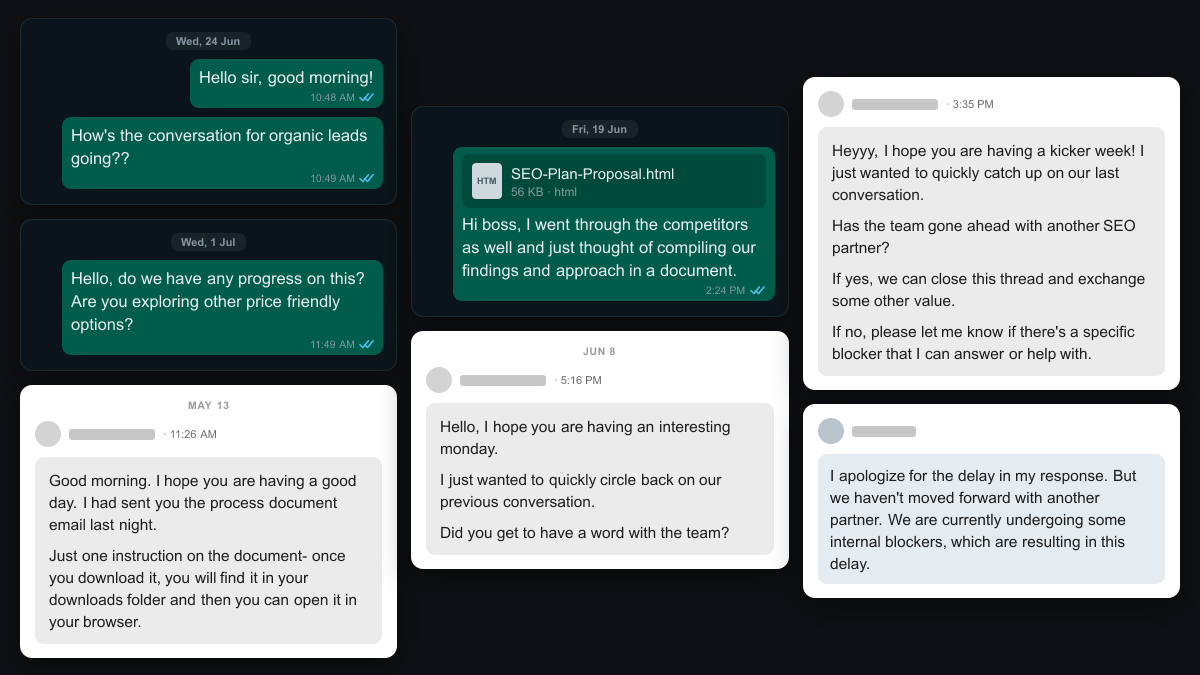
Your product works.
The demo goes well. The prospect leans in, says "this is exactly what we've been looking for," and asks you to send a proposal by Friday.
You send it Thursday.
Then: nothing. You follow up. Nothing. You follow up again, this time with a "just bumping this to the top of your inbox." And eventually you get the email every founder can recite from memory:
"Thanks for this. We're discussing internally — let's revisit next quarter."
Next quarter never comes.
I've spent 12 years building digital products and scaling them organically, and the last three helping 50+ SaaS and services businesses do the same. In almost every one of those businesses, the founder came to me with the same sentence: our sales cycle is too long, and I've felt that myself for my business. They wanted a better closer, a tighter follow-up sequence, a sharper deck.
Almost none of them had a sales problem.
So let me give you the honest answer to why your B2B SaaS sales are slow, and it's the one your sales stack will never tell you:
Your deal isn't slow. Your buyer is just doing most of the buying without you.
The deal was mostly decided before you ever got the meeting
Think about the last piece of software you bought for your company.
You didn't call a salesperson and ask them to educate you. You Googled the problem. You read a comparison post. You lurked in a Slack community. You asked two friends. You watched a couple of videos, looked at the pricing, and came back a week later. You quietly built a shortlist in your head. And then — only then — you booked a demo.
By the time you got on that call, you weren't being educated. You were confirming a decision you'd already half-made.
Your buyers do exactly the same thing to you.
So when you finally get them on a call, you're not entering the evaluation. You're arriving at the end of it. You're either being confirmed or eliminated — and the work that decided which one happened weeks ago.
This is the single most expensive misunderstanding in B2B SaaS. You think you're the one selling. You're not. Your buyer is selling you to themselves, and to their boss, using whatever material they can find. If you didn't give them that material, they used someone else's.
Why B2B SaaS sales are slow: the five real causes
When I audit a B2B SaaS site, I'm not looking at keyword rankings first. I'm looking for where the pipeline leaks. It's almost always one of these five.
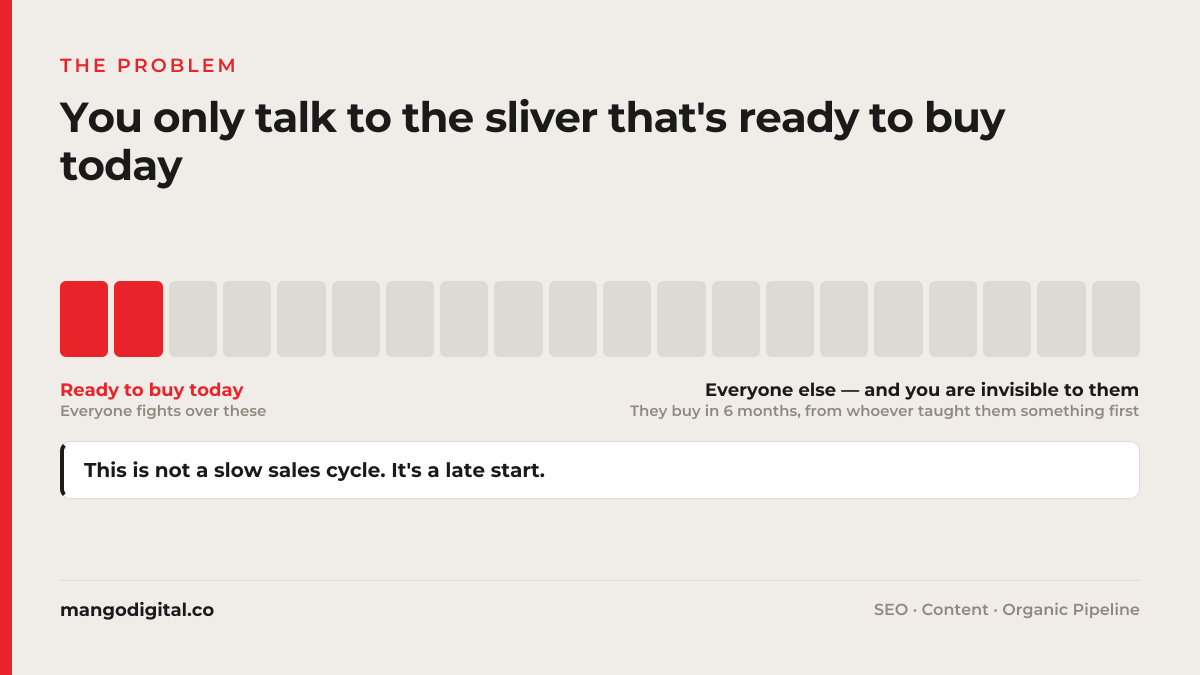
1. You only talk to people who are ready to buy today
At any given time, only a small fraction of your market is actually looking to buy. The rest of them have a problem they haven't named yet, some are struggling to identify the ideal budget, some are looking to optimise things "internally" or cut down on other purchases, and some still don't know they can find a solution like yours.
Most SaaS companies build sales strategies for those who are ready to pay today- this dilutes their future prospects and clogs their pipeline, also making them invisible to every other potential customer.
As a result, when these prospects are ready and primed, they don't even know you exist- and hence, even if they get on a discovery call, and then a sales call with you, they pay a competitor who they heard of four months before they knew your name.
This is not a slow sales cycle. It's a late start.
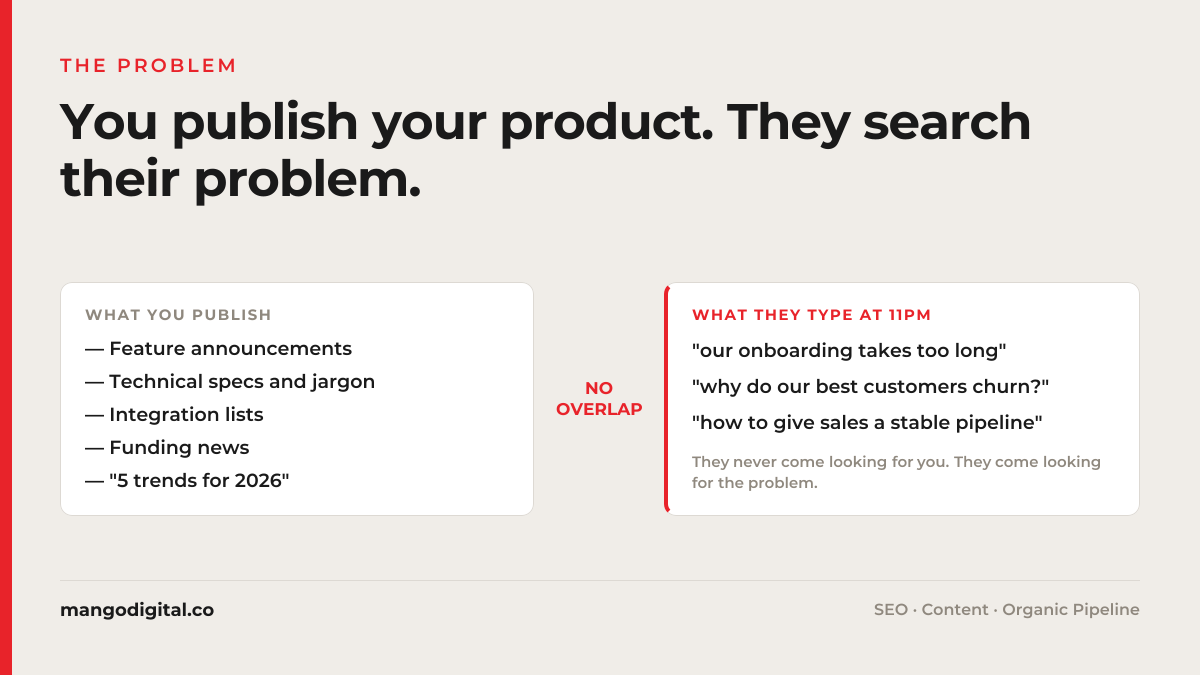
2. Your content talks about your product. Your buyer is searching for their problem.
Go look at your blog right now. I'll wait.
Most B2B SaaS companies position their content strategy to talk more and more about their product, its features, descriptions, technical details, specifications- basically jargon that they are obsessed with!
Pretty passionate in my opinion- only if their customers were ready to care for this information, they'd make more sales.
Your goal should be to target what your buyer actually types into Google at 11pm when their problem keeps them up at night.
They don't search your category- honestly, they don't care about "your category," not when they have a business that requires them to sell more to pay the bills. So, they search the symptoms-
- "our onboarding takes too long"
- "why do our best customers churn after 3 months?"
- "how to give the sales team a stable pipeline without another tool?"
In simple words- they are searching for the pain they are dealing with. If your content only talks about the solution- ideally your product, they'll never be able to find you- because, they'll never come looking for you, but the problem.
3. Nothing on your site de-risks the decision
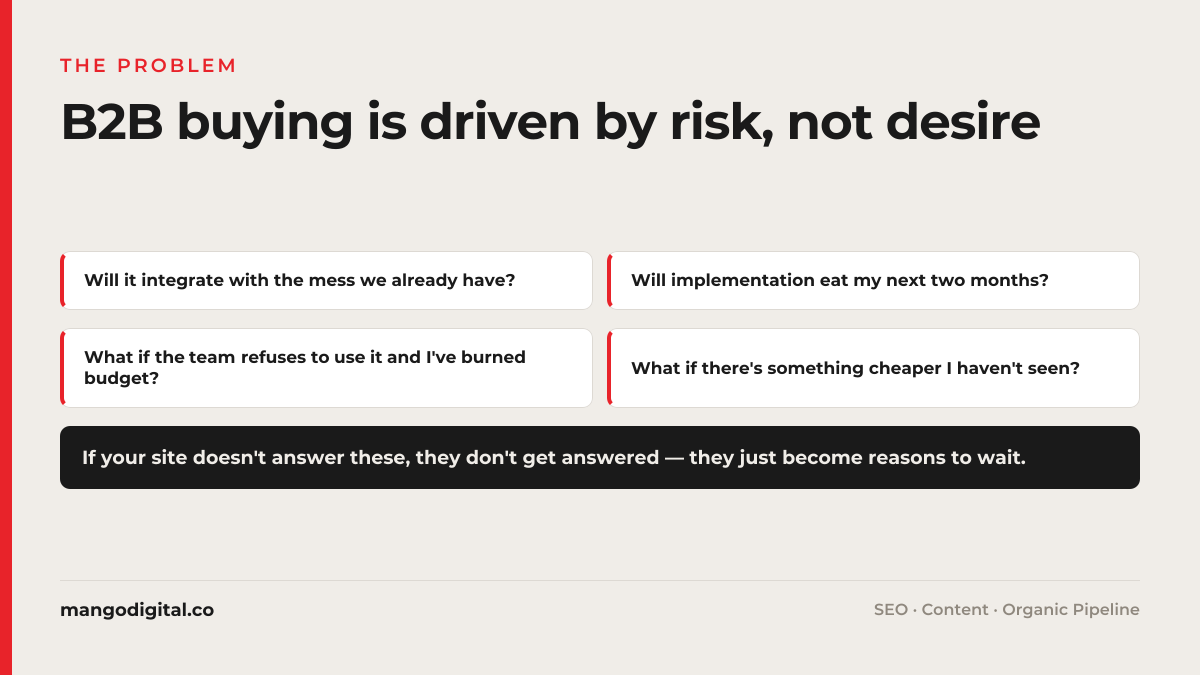
B2B buying is not driven by desire. It's driven by risk-
A bad investment in a B2B setting does not only drain money; it drains time, resources, reputation, productivity, the potential growth, and credibility.
With stakes that high, the buyer is always asking these questions-
- What if it doesn't integrate with the mess we already have?
- What if implementation eats my next two months?
- What if the team refuses to use it and I've burned the budget?
- What if there's something cheaper I haven't seen?
And if your website does not precisely answer these questions- you are playing luck and hope; which converts one out of a thousand or ten thousand prospects!
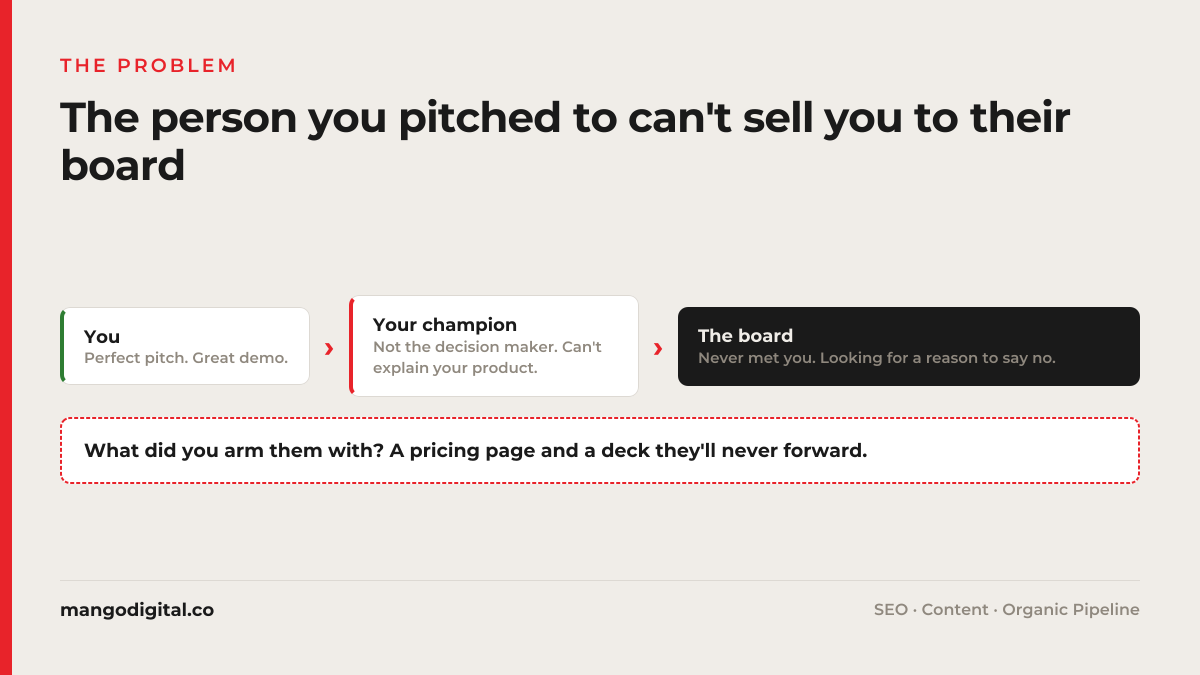
4. The person you pitched to can't sell you to their board
The single reason I have lost most of my B2B SaaS sales to- the person I pitched to didn't have the right arsenal to sell me to their team.
While you may give the perfect plan and offer to your prospect, in most B2B settings, they are not the ultimate decision makers in their company and they don't possess the knowledge or skill around your product to sell it to their board.
Result? Of course you know!
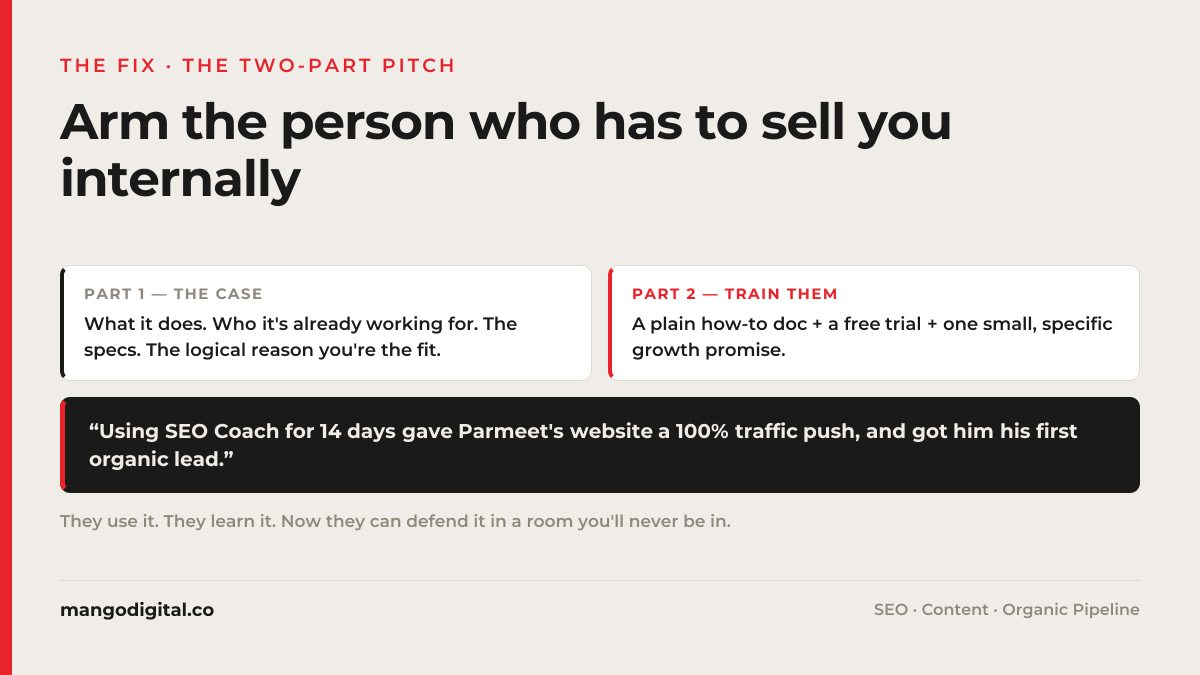
To mitigate this, you can prepare your pitch into two parts-
- Where you tell them what your product does, how it is helping other businesses like theirs, technical specs, logical reasons why you are the perfect fit.
- You slyly train them around using your product- send them a straightforward How-to document- and send a free trial with a small growth promise, if they use your product across the trial period. For example, when I pitch my SEO Coach to my SEO & Sales Funnel Audit tool users, I tell them-
"Using SEO coach for 14 days gave Parmeet's website a 100% traffic push, and got him his first organic lead."
This simply tells my existing users that upgrading (even without paying) can help them get good results, so they use the product for 14 days, learn how it works to maximize their SEO output, and are well prepared before they go out selling to their board.
5. The middle of your website is missing
Every time I run a funnel audit, I see the same shape. It's so consistent it's almost funny.
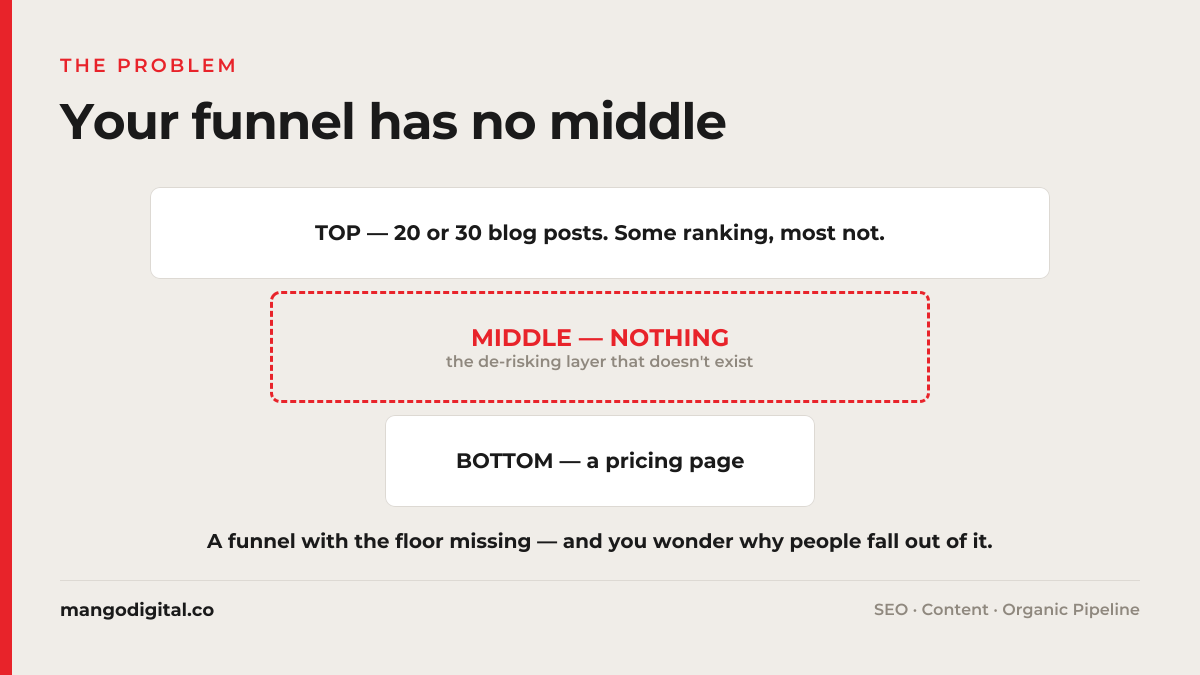
- Top of funnel: 20 or 30 blog posts. Some ranking, most not.
- Bottom of funnel: a pricing page. A demo form. Maybe a features page.
- The middle: nothing. An absolute void.
Top and bottom, no middle. And the middle is exactly where B2B deals are actually won or lost- because the middle is the de-risking layer. It's where a curious reader becomes a confident buyer and your product transitions from being "interesting" to becoming "defensible."
You've built a funnel with the floor missing and you're wondering why people fall out of it.
Why pushing harder makes it slower?
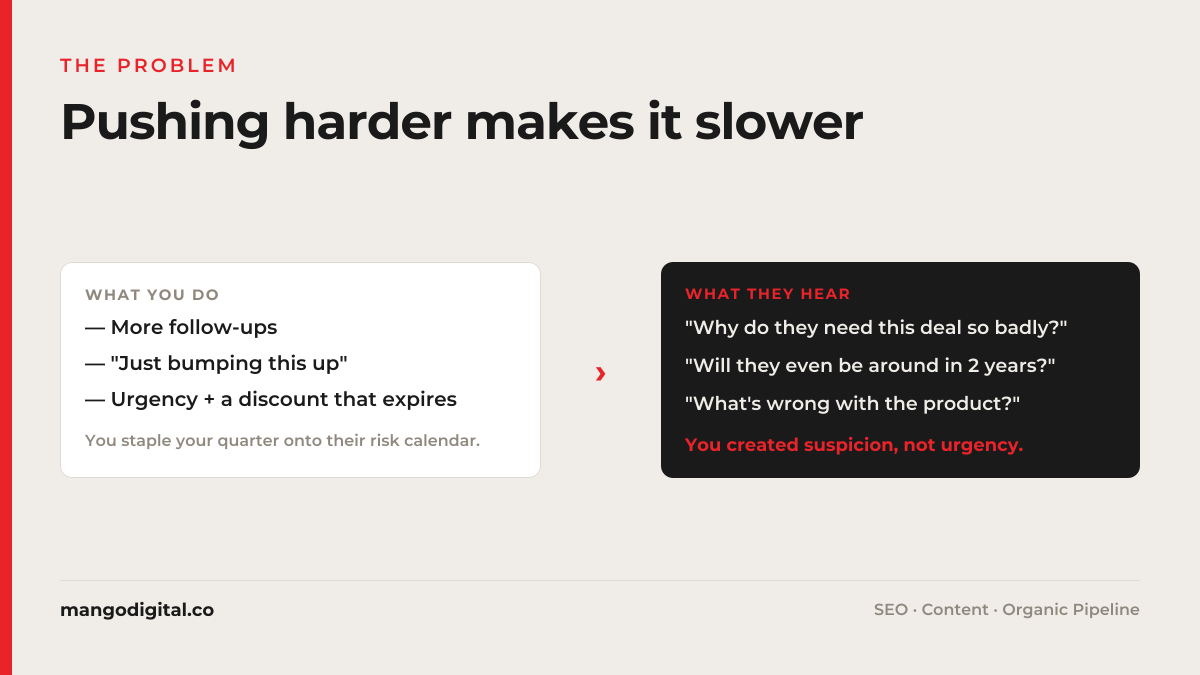
The instinct, when deals stall, is to push. More follow-ups. More urgency. A discount with an expiry date.
Understand what that actually does.
Aggressive sales tactics take your timeline — your quarter, your runway, your board meeting — and try to staple it onto their risk calendar. The buyer feels it immediately. And here's the part founders miss: pressure reads as risk. A vendor chasing this hard, discounting this fast, must need this deal badly. Are they going to be around in two years? What's wrong with the product that they're pushing so hard?
You think you're creating urgency. You're creating suspicion.
Content does the exact opposite. It lets the buyer move at their own pace, on their own time, without ever having to talk to you — while you quietly stay in the room the entire time. It is the only salesperson you have that works while your buyer is actively avoiding salespeople.
The playbook, in the order I'd actually do it
Now the part that will annoy every agency that ever pitched you.
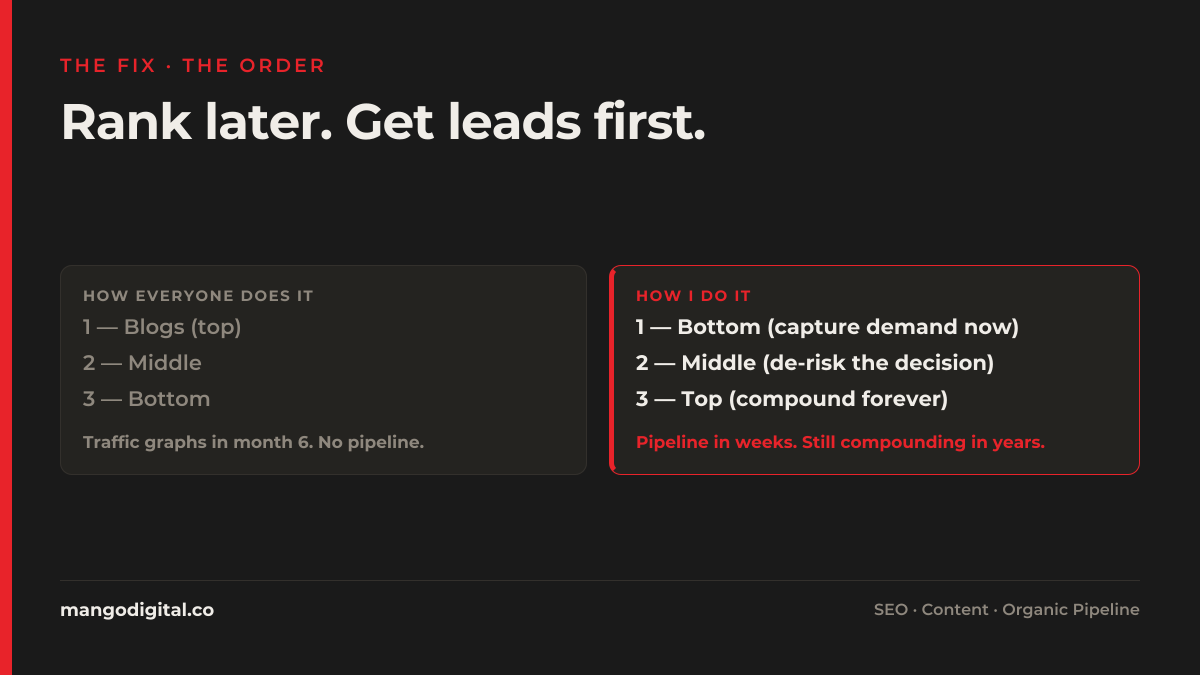
Do not start with blogs.
Everyone starts with blogs, because blogs are easy to produce and easy to put in a report. Twelve posts, some traffic graphs going up and to the right, and no pipeline for six months. I've watched founders pay for that for a year and quietly conclude that "SEO doesn't work in our industry."
SEO works fine. The order is wrong.
Rank later. Get leads first. Here's the sequence I use.
Step 1. Build the bottom first (weeks 1-4)
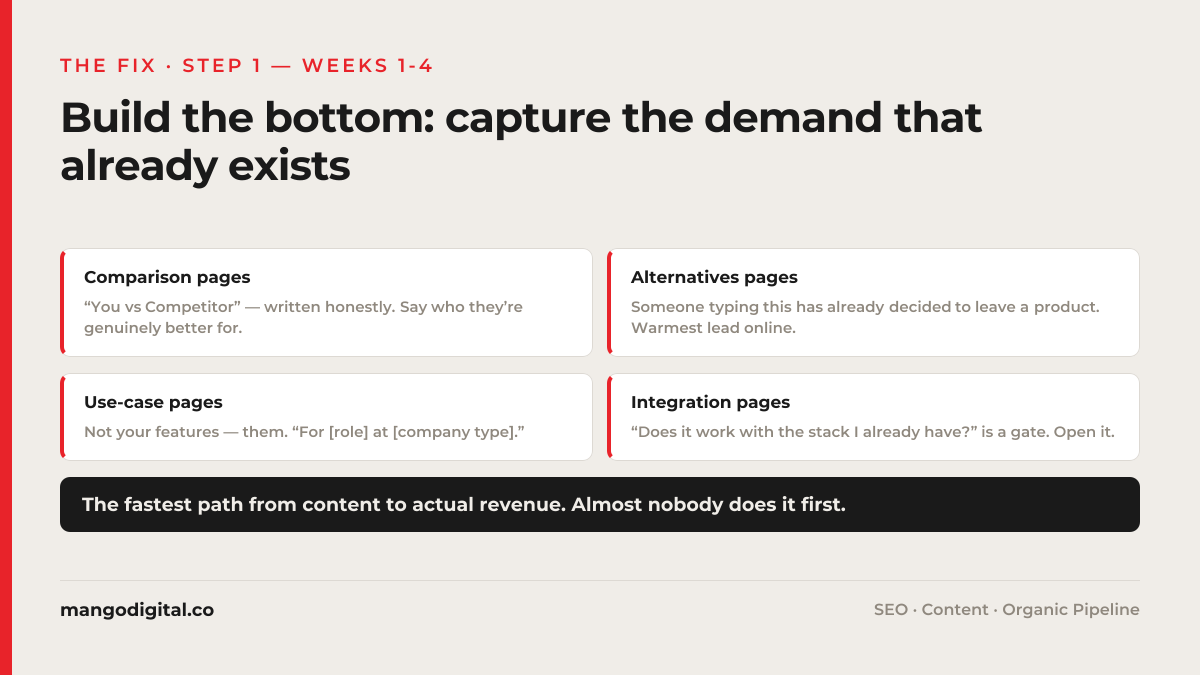
Go capture the demand that already exists. These people are in-market right now, actively searching, ready to buy from somebody. Give them a reason for it to be you:
- Comparison pages — "[You] vs [Competitor]". Write it honestly. Say who your competitor is genuinely better for. That single act of honesty converts better than any amount of feature-listing, because it's the first time all week your buyer has read something that wasn't marketing.
- "Alternatives to [Competitor]" pages — someone typing this has already decided to leave a product. They're the warmest lead on the internet.
- Use-case pages — not "our features," but "[Your product] for [specific role] at [specific company type]." Buyers need to see themselves, not your product.
- Integration pages — "Does it work with the stack I already have?" is a gate. Open it.
This is a handful of pages. It's the fastest path from content to actual revenue in B2B SaaS, and almost nobody does it before they do blogs.
Step 2. Build the middle (weeks 4-10)
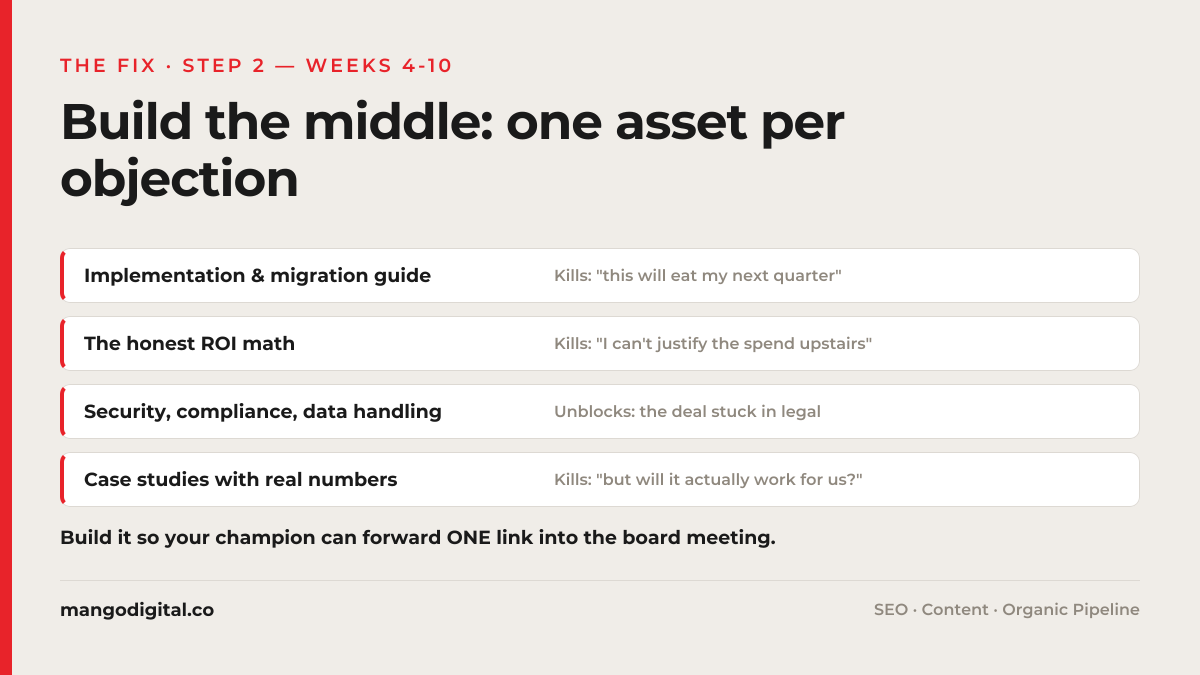
This is the de-risking layer. Every asset here exists to kill one specific objection:
- Implementation and migration guides — "what the first 30 days actually look like." Kills the "this will eat my quarter" fear.
- The honest ROI math — shows the calculation. Show your assumptions. Don't hide behind "contact sales."
- Security, compliance, data handling — a boring page that unblocks enterprise deals stuck in legal.
- Real case studies with real numbers — not "Acme loved working with us," but the before number, the after number, and how long it took.
- Free trial and the motivation to use it — The person you pitch to and impress upon should have your free trial, with the right motivation to use it. Tie the free trial’s usage to a small glimpse of the desired outcome your ICP would love to notice in the next 14 days. See, how I like my SEO Coach to a user’s success- "Using SEO coach for 14 days gave Parmeet's website a 100% traffic push, and got him his first organic lead."
Almost no one does this, and it's the single highest-leverage content you can produce.
Step 3. Build the top (ongoing, ever-expanding, forever)
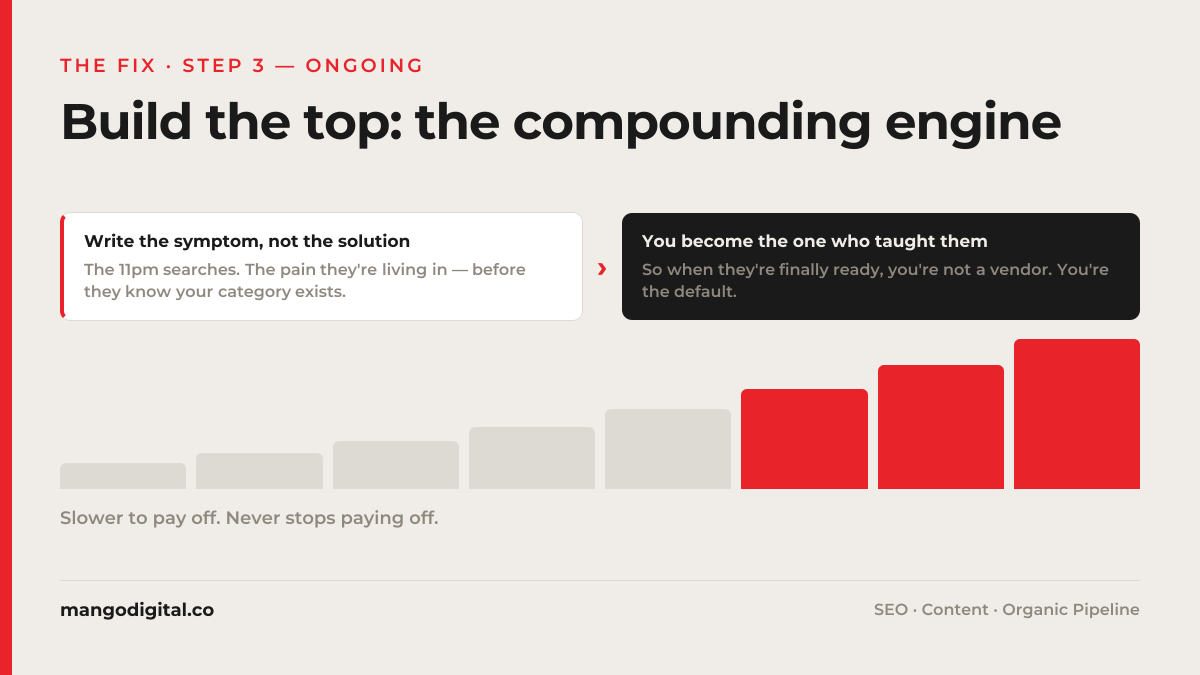
Now write the problem-aware content. The 11pm-search stuff. The symptoms, not the solution. This is the compounding engine — it's slower to pay off and it never stops paying off, because it makes you the company that taught them how to think about the problem before they knew they had a category to buy in.
Do it in this order and your content will start producing pipeline in weeks instead of quarters, while still compounding for years.
What this actually looks like when it works
Let me be honest about the timeline, because the gurus won't be.
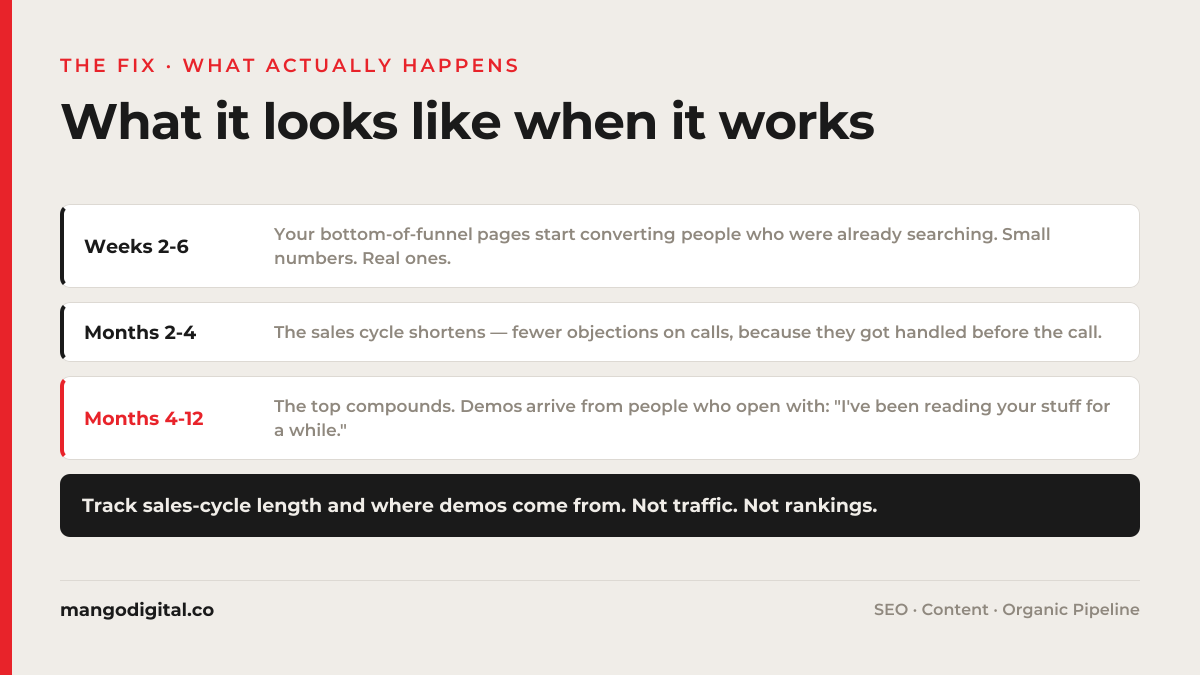
- Weeks 2-6: Your bottom-of-funnel pages start converting the people who were already searching. Small numbers. Real ones. Quick wins.
- Months 2-4: Your sales cycle starts shortening. You'll notice it in a strange, quiet way — fewer objections on calls, because the objections got handled before the call.
- Months 4-12: The top of funnel compounds. Demos start arriving from people who open with the sentence you want to hear more than any other: "I've been reading your stuff for a while."
That sentence is the whole game. When a buyer says that, the deal isn't slow. Trust was already built. You're not selling anymore, you're just confirming.
And notice what I did not promise you: traffic. Rankings. Impressions. Those are the metrics you get shown when the work isn't producing money. The metrics that matter here are sales cycle length and where your demos are coming from. Track those instead.
The uncomfortable truth
Content is slower to start and faster to compound than ads. That's the trade-off.
For a founder in a hurry, this is not the perfect fit and that is exactly why most of your competitors won't do it properly, and also why it will work for you.
Your sales aren't slow because you aren't pushing hard enough.
They're slow because when your buyer was quietly deciding — reading, comparing, building the internal case, trying to convince their boss — you weren't in the room.
Content is how you get in the room.
Build the bottom. Then the middle. Then the top. Stop chasing people who were never ready, and start being findable to the ones who will be.
It's genuinely easier than the internet gurus have told you.
Want to know where your funnel is actually leaking? Run a free audit of your site — it maps your content against every stage of the funnel and shows you exactly which layer is missing. It takes about 90 seconds, and it will probably tell you your middle is empty.