How to write content in 2026- straight from a writer's desk!
There was a time when writing a blog felt very simple. You pick a topic, add some keywords, write 800–1000 words, insert a few headings, maybe add a backlink somewhere… and that was it. If everything went well, your blog ranked. If not, you blamed competition or keywords and moved on.
There was a time when writing a blog felt very simple. You pick a topic, add some keywords, write 800–1000 words, insert a few headings, maybe add a backlink somewhere… and that was it. If everything went well, your blog ranked. If not, you blamed competition or keywords and moved on.
That approach worked. For years. But somewhere along the way, things started changing quietly.
Search results stopped looking the same. People stopped clicking on blogs the way they used to. And most importantly, answers started appearing before users even opened a website.
If you notice carefully today, when you search for something, you often don’t feel the need to open multiple blogs anymore. The answer is already there; clean, direct, and immediate.
That shift didn’t happen randomly. It happened because we are no longer just writing for search engines. We are writing for systems that understand, summarize, and present content differently.
And that’s exactly why blog writing in 2026 is not just about SEO anymore.
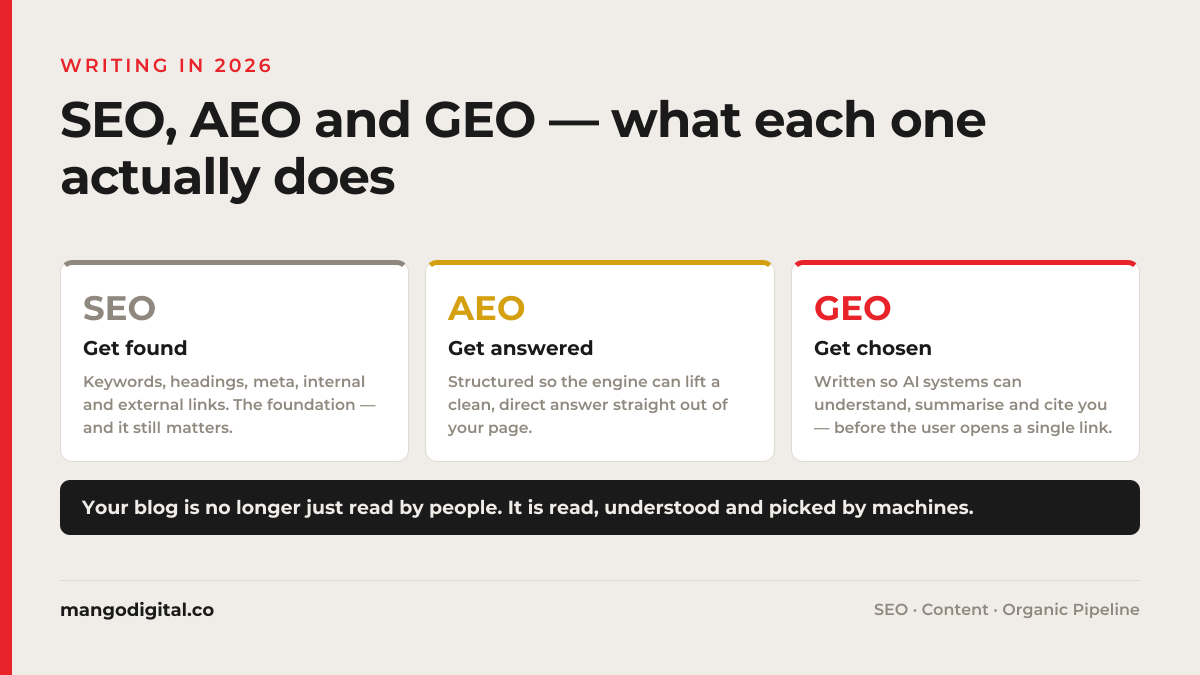
Now, it’s about understanding three things properly: SEO, AEO, and GEO.
If you understand these three in the right way, your writing automatically improves. And if you ignore them, even well-written blogs can start feeling invisible.
First, Let’s Talk About What Changed
Earlier, when someone searched something, they had to go through multiple links to find the right answer. Now, people expect the answer immediately.
They don’t want to read five paragraphs just to understand one small thing. They don’t want to scroll endlessly to find the point. And they definitely don’t want content that feels like it was written just to rank.
This change in behavior has completely shifted the way content needs to be written.
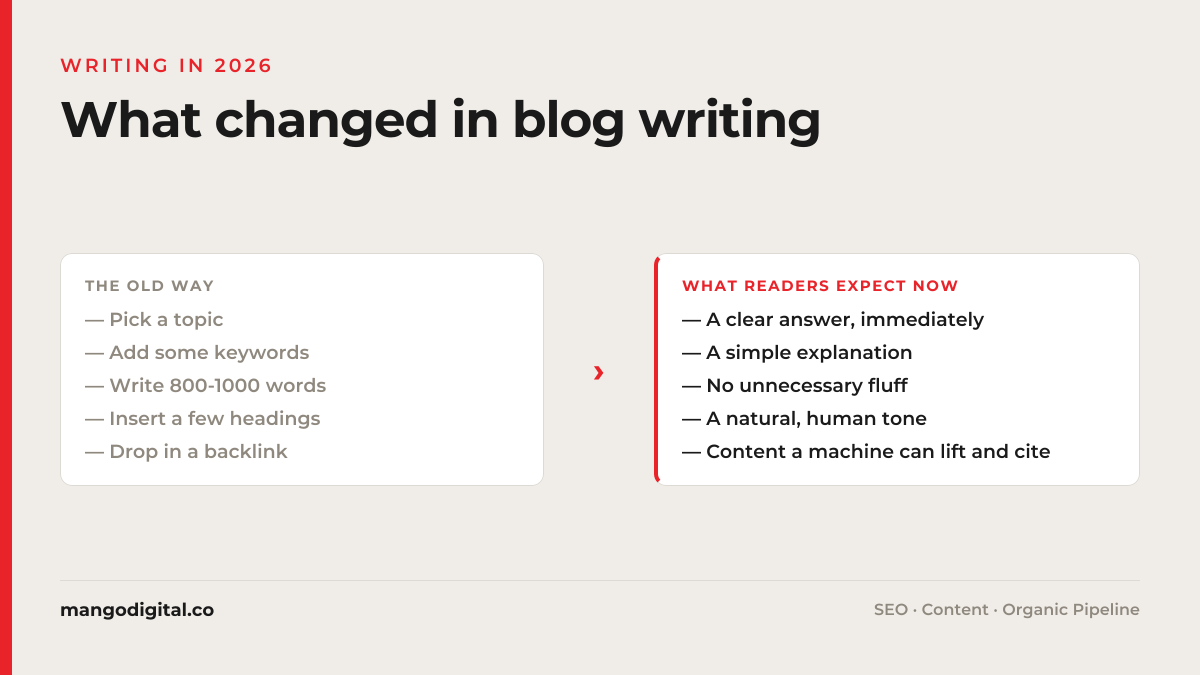
Now the expectation is:
- Clear answer
- Simple explanation
- No unnecessary fluff
- Natural tone
And the biggest change? Your blog is no longer just read by people. It is also read, understood, and picked by AI systems.
That means your writing is not just competing with other blogs anymore. It is competing to be selected, summarized, and shown directly to the user.
That’s where SEO, AEO, and GEO come in.
SEO (The Foundation That Still Matters)
SEO, or Search Engine Optimization, is what most of us have been doing all along.
It includes things like using the right keywords, optimizing headings, writing meta descriptions, adding internal and external links, and making content rank well in search engines. This is the base.
And no, SEO is not dead.
It still matters because search engines still need signals to understand what your content is about. Keywords still help. Structure still helps. Optimization still plays an important role.
But here’s the problem. If you only focus on SEO the old way, just inserting keywords and trying to rank, your content starts feeling forced.
You might rank, but you may not get clicks. Or even if you get clicks, users may not stay. Because SEO alone does not guarantee clarity anymore. It only helps you get discovered.
What happens after that depends on something else.
Then Comes AEO (Where Content Starts Changing)
AEO stands for Answer Engine Optimization. And this is where writing starts becoming more human and more precise at the same time. Think about how people search today.
They don’t type random words anymore. They ask questions.
“How to lose weight fast?”“What is cysteine hair treatment?”“Best time to eat dry fruits”
They are not looking for a blog. They are looking for an answer. AEO focuses on exactly that. Instead of making users work to find the answer, you give it to them immediately.
No long introductions. No delay. No confusion. Just a clear, direct response.
This is the kind of content that gets picked for:
- Featured snippets
- Voice search results
- Quick answer boxes
And if you notice carefully, these answers are usually simple, structured, and straight to the point. That doesn’t mean your blog becomes short. It just means your blog becomes smarter.
You start with the answer, and then you expand. You respect the reader’s time.
And when you do that, your content naturally performs better.
Now Let’s Talk About GEO (This Is Where Most People Get Confused)
GEO stands for Generative Engine Optimization.
It sounds technical, but it’s actually very simple if you understand the idea behind it. Earlier, search engines showed links. Now, AI tools generate answers.
That means your content is not just being ranked. It is being read, understood, and sometimes rewritten in a summarized form. And then shown to users.
So the question is not just:“Will my blog rank?”
The question is:“Will my content be chosen by AI to represent this topic?”
That’s a completely different level of writing. Because AI doesn’t pick content based on keyword stuffing or length.
It picks content that is clear, trustworthy, well-structured, easy to understand, and natural in tone. If your blog feels confusing, repetitive, or unnecessarily complicated, it simply gets ignored.
But if your blog feels clean, logical, and genuinely helpful, it has a much higher chance of being used. So GEO is not about tricks.
It’s about writing in a way that both humans and AI can understand without effort.
So What Does Blog Writing in 2026 Actually Look Like?
This is the part that matters the most. Because understanding concepts is one thing. Actually applying them while writing is something else. Let’s break it down in a very real way.
1. You Don’t Start With a Long Introduction Anymore
Earlier, we were taught to build context slowly. Now, that doesn’t work. If someone clicks on your blog, they expect clarity within seconds.
So instead of writing three paragraphs before getting to the point, you start with the answer. You can still write an introduction, but it should feel relevant and engaging, not stretched.
2. You Write Like You Speak
This is something most people struggle with. They try to sound professional, and in that process, they lose clarity.
In 2026, natural writing works better than complicated writing. If a sentence feels like something you wouldn’t say out loud, it probably needs to be simplified. Because readers connect with clarity, not complexity.
3. You Focus on Intent, Not Just Keywords
Earlier, the goal was to insert keywords properly. Now, the goal is to understand why someone is searching.
What are they actually trying to know? Are they confused? Curious? Comparing options?
Once you understand that, your content automatically becomes more useful. And when content becomes useful, it performs better without forcing it.
4. You Structure Content Properly
This part is more important than most people realize. Even if your content is good, poor structure can ruin it. In 2026, structure plays a huge role because both users and AI scan content before reading it fully.
So your blog should have clear headings, short paragraphs, logical flow, and no unnecessary repetition. Each section should feel connected, not random.
5. You Stop Writing Just to Fill Word Count
This is a big shift. Earlier, longer blogs were often considered better Now, unnecessary length can actually hurt you.
If your blog feels stretched just to reach a word count, it becomes tiring to read. Instead, every paragraph should have a purpose. If something doesn’t add value, it doesn’t need to be there.
6. You Make Content Easy to Pick and Use
This is where GEO actually starts making a real difference.
Your content should be written in a way that is easy to understand, extract, and use. That means clear sentences, no confusion, no mixed ideas, and simple explanations
Think of it this way. If someone had to pick one paragraph from your blog and show it as an answer, would it make sense on its own? If yes, you’re writing it right.
A Simple Way to Understand the Difference
Instead of making this too technical, let’s keep it simple.
SEO helps your blog get found.AEO helps your blog answer clearly.GEO helps your blog get chosen.
All three matter. But the priority has shifted. Earlier, ranking was everything. Now, clarity and usefulness matter more.
What Most People Are Still Doing Wrong?
Even today, many blogs fail not because the writer is bad, but because the approach is outdated.
Some common mistakes are:
- Writing long intros without giving value
- Repeating the same idea in different words
- Forcing keywords unnaturally
- Ignoring structure
- Writing in a robotic or overly formal tone
These things might have worked earlier. But now, they make content weaker. Because readers notice it immediately. And AI systems do too.
What Actually Works Now?
If you look at blogs that perform well today, you’ll notice a pattern.
They feel easy to read. They don’t try too hard. They don’t sound forced. They explain things clearly. And most importantly, they respect the reader’s time.
That’s the kind of writing that works in 2026. Not because of tricks, but because it makes sense.
So, How Should You Start Writing Now?
If you’re someone who writes blogs regularly, you don’t need to completely change everything overnight. You just need to adjust your approach slightly.
Start by asking yourself simple questions:
Am I answering the user’s question clearly? Is my writing easy to understand? Does my content feel natural? Is the structure clean?
If the answer is yes, you’re already moving in the right direction.
The Real Shift Is Not Technical, It’s Mindset!
This is important. Most people think blog writing has become more technical. But actually, it has become more human.
The focus is no longer on manipulating search engines. It’s about helping people understand things better. And when you do that genuinely, everything else starts falling into place
Blog writing in 2026 is not about choosing between SEO, AEO, and GEO. It’s about understanding how all three fit together.
SEO helps you get visibility.AEO helps you deliver answers.GEO helps you stay relevant in an AI-driven space.
If you ignore any one of them, your content feels incomplete. But if you understand all three in a simple, practical way, your writing naturally becomes stronger.
And you don’t need to overcomplicate anything. You just need to write clearly, honestly, and with intention.
Because at the end of the day, no matter how much things change, one thing remains the same. Good writing always works. You just have to adapt it to how people read today.
Read next
→ How We Turn Okay Content into Wow Content — the editing system every draft goes through.
Not sure what is actually holding your website back? Run a free SEO audit — it maps your site against every stage of the funnel in about 90 seconds and shows you exactly which layer is missing.